Requirements
- 1.
Be at least in the 7th grade.
- 2.
Review six points in the selection of a good campsite. Review the safety rules of firebuilding.
- 3.
Go on a weekend campout.
- 4.
Lay the following three fires and tell their uses:
- a.
Hunter's fire
- b.
Reflector fire
- c.
Star fire
- a.
- 5.
Know six ways to start a fire without a match. Build a campfire using one of these:
- a.
Compressed air d. Friction
- b.
Curved glass e. Metal match
- c.
Flint f. Spark
- a.
- 6.
Know how to properly sharpen a hatchet and knife.
- 7.
Cook a one-pot meal using fresh or dried food.
- 8.
Describe the various types of tents and their uses.
- 9.
How does condensation occur in tents, and how can it be prevented?
- 10.
Demonstrate your ability to anchor a tent down, using the taut-line hitch and two half hitches.
- 11.
While camping, plan and give a ten-minute devotional or organize and lead a nature or Bible game or lead out in Sabbath School, camp church, or camp vespers.
- 12.
Properly locate and build one of the following and describe its importance to the individual and the environment:
- a.
Camp sink and dishwashing area
- b.
Latrine
- c.
Shower
- a.
- 13.
Demonstrate four basic lashings and construct a simple object using these lashings.
- 14.
Know how to replace the mantels on a camp lantern. Demonstrate how to refill gas in a camp lantern and stove. Know how to maintain the pressure pump on a camp stove in good working order. Note: The tent color for Camping Skills #3 is green.
Helps for leaders
Teaching notes from the official document, numbered to match the requirements above.
Hi Everyone! This is Crysfel Villa, a Master Guide who have been camping, hiking and climbing mountains all around the world, I love getting surrounded by God's creation. This guide follows the 14 official honor requirements and provides explanations, practical examples, and activities to help instructors teach each one.
Camping is one of the best ways to learn skills that are difficult to teach inside a classroom. It challenges us to solve problems, work together, become more resourceful, and appreciate God's creation. Whether you're preparing for your first overnight trip with Pathfinders or have been camping for years, there's always something new to learn.
This is a work in progress guide, I'd expect for instructors to cover all this content in two or three sessions, there's a lot of content here and it's better to have a hands on experience.
A note about safety: Firebuilding, cutting tools, fuel-powered equipment, and backcountry sanitation require appropriate supervision. Always follow local regulations, campground policies, manufacturer instructions, and your conference's youth safety requirements.
1. Age and Grade Requirement
Requirement: Be at least in the 7th grade.
Camping Skills III is designed for Pathfinders who are ready to take on more responsibility and learn advanced outdoor skills. At this level, students should begin moving beyond simply following instructions. Encourage them to understand why things are done a certain way and to make responsible decisions.
For example, instead of telling a Pathfinder where to pitch a tent, ask them to evaluate two possible locations and explain which one they would choose. This helps develop judgment, independence, and leadership.
Instructor tip: Consider assigning experienced Pathfinders responsibility for helping younger members during campouts, while maintaining appropriate adult supervision.
2. Choosing a Good Campsite
Requirement: Review six points in the selection of a good campsite. Review the safety rules of firebuilding.
Choosing the right campsite is one of the most important decisions you'll make when camping. A good location can make your trip comfortable and enjoyable, while a poor choice can lead to sleepless nights, unexpected challenges, or even dangerous situations.
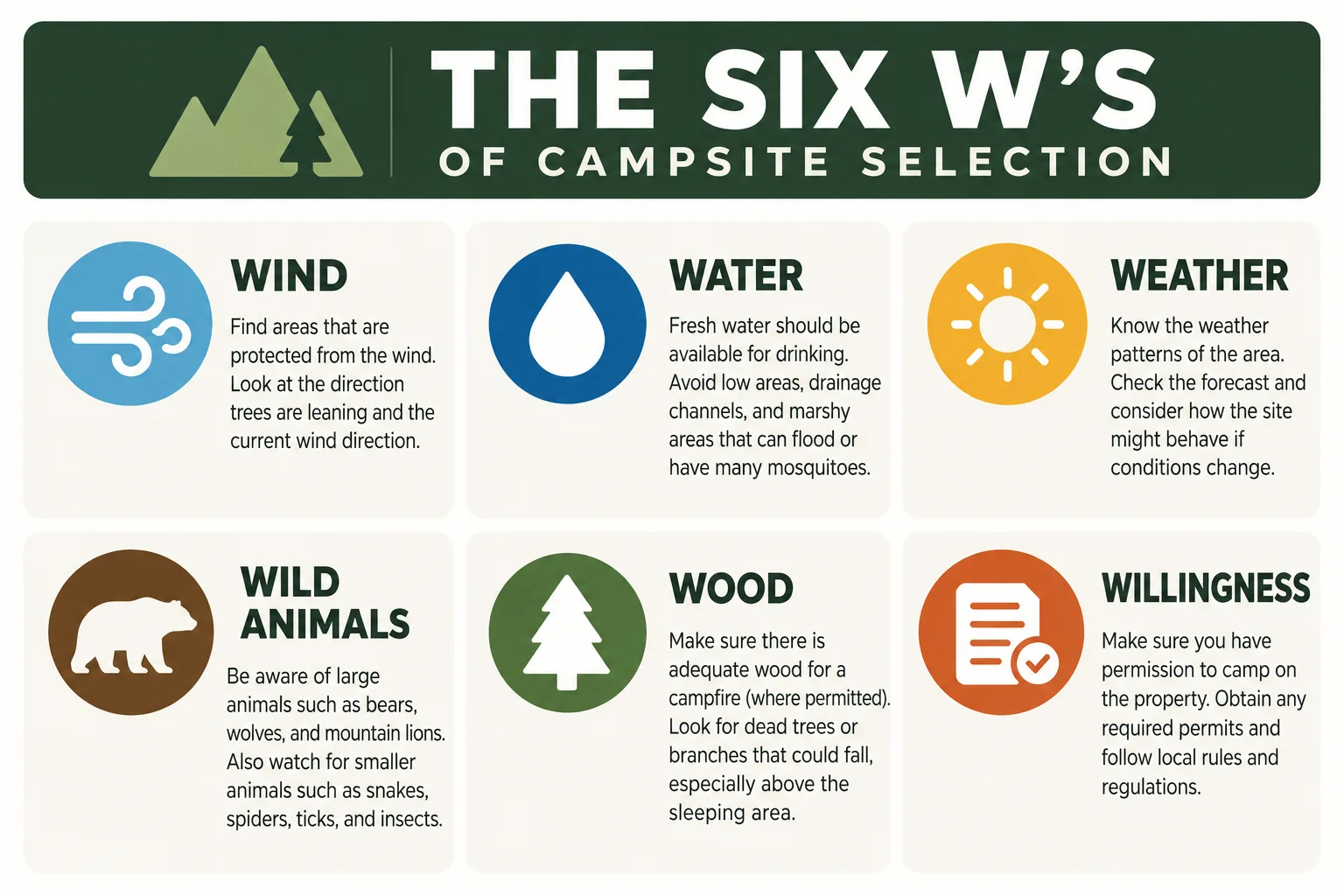
Before setting up your tent, take a few minutes to explore the area and evaluate your surroundings. An easy way to remember what to look for is by using the six W's of campsite selection: Wind, Water, Weather, Wild Things, Wood, and Willingness.
1. Wind 🌬️
Look for a campsite that offers natural protection from strong winds. Wind can make camping uncomfortable, especially during cold nights. Strong gusts can also damage tents or pull stakes out of the ground.
To determine the prevailing wind direction, observe your surroundings. Trees that consistently lean in one direction may provide clues about long-term wind patterns. You can also look at the current wind direction, although it may change throughout the day. Natural features such as hills can provide some protection, but avoid camping beneath unstable trees or branches.
Instructor tip: Ask Pathfinders to observe the wind direction and identify which areas of the campsite offer the best protection.
2. Water 💧
Access to clean drinking water is important, particularly during longer camping trips. However, camping near water also introduces potential hazards.
Avoid setting up tents in dry creek beds, drainage channels, or low-lying areas that could flood during heavy rainfall. Even if the weather is clear where you're camping, storms upstream can cause sudden flooding. Marshy areas and standing water can also attract mosquitoes and other insects, making camping uncomfortable.
When camping in the backcountry, follow local regulations and generally stay at least 200 feet away from lakes and streams. Remember that water from rivers, lakes, and streams should be properly treated before drinking, even when it looks clean.
Instructor tip: Have students identify potential water sources and discuss which areas might become dangerous during heavy rain.
3. Weather ⛅
Understanding local weather patterns helps you select a safer campsite. Before leaving home, check the forecast for the entire trip, including overnight temperatures, wind speeds, and the possibility of thunderstorms. Consider how the campsite might behave if conditions change. For example, a low area might collect rainwater, while an exposed hilltop could become dangerous during a thunderstorm. Temperatures can also drop significantly overnight, especially at higher elevations.
Instructor tip: Ask Pathfinders to check the weather forecast before the campout and explain how it influenced their campsite selection.
4. Wild Animals 🐻
Remember that when we're camping, we're visiting the natural habitat of many animals. Before choosing a campsite, look for signs of wildlife, including tracks, droppings, burrows, and evidence of recent animal activity. Depending on the region, larger animals such as bears, mountain lions, or wolves may be present. But don't forget about smaller creatures! Snakes, spiders, ticks, biting flies, and mosquitoes can also create problems.
Avoid placing tents near animal trails, dense vegetation that may conceal hazards, or areas with signs of significant wildlife activity. Food storage is especially important. Follow local wildlife guidance and keep food, trash, and scented items secured appropriately.
Instructor tip: Take Pathfinders on a short nature walk and ask them to identify signs of animal activity without disturbing wildlife.
5. Wood 🌳
Wood has traditionally been an important consideration when choosing a campsite, particularly when campfires are permitted. However, having plenty of wood nearby doesn't necessarily mean it's safe or appropriate to collect or burn it. Always check local fire restrictions and campground regulations.
When gathering firewood is permitted, use only approved sources and follow Leave No Trace principles. More importantly, look up before setting up your tent! Dead branches, damaged trees, and unstable trunks can fall unexpectedly, especially during strong winds. These hazards are sometimes called widowmakers because falling branches can cause serious injuries.Avoid pitching tents beneath dead branches or trees that show signs of instability.
Instructor tip: Ask students to inspect the trees surrounding a potential campsite and identify overhead hazards.
6. Willingness 📋
Before camping anywhere, make sure you have permission. If the land is privately owned, obtain permission from the property owner. If you're camping in a state park, national park, or other managed area, check whether reservations or permits are required, most parks require you to reserve the campsites in advance.
Some areas also have restrictions on campfires, group sizes, camping locations, and overnight stays. For Pathfinder clubs, make sure the trip also complies with your conference's policies and requirements. Respecting property owners, park regulations, and other campers is part of being a responsible outdoors person.
Instructor tip: Have students research a nearby campground and identify its reservation requirements, fire regulations, and group camping policies.
🏕️ Practical Activity: Choose Your Campsite
Estimated duration: 20–30 minutes
Objective: Help Pathfinders apply the six W's when evaluating a potential campsite.
Instructions
- Divide Pathfinders into small groups.
- Walk around an approved camping area and identify two or three possible tent locations.
- Ask each group to evaluate the locations using the six W's.
- Have students select their preferred location and explain their reasoning.
- Discuss the advantages and disadvantages of each choice.
Discussion Questions
- Which of the six W's was most difficult to evaluate?
- Would your preferred location change if heavy rain were expected?
- What hazards might be difficult to notice during daylight?
- Why should we inspect the area above our tents, not just the ground?
- How can we minimize our impact on the environment?
Key takeaway: A good campsite isn't simply a beautiful location. It's a place where we can camp safely, comfortably, legally, and responsibly while protecting the surrounding environment. Here's a cheat sheet you can print and hand out to your pathfinders.
3. Participate in a Weekend Campout
Requirement: Go on a weekend campout.
A weekend campout is an opportunity to put everything into practice. Encourage Pathfinders to participate in the planning process rather than simply arriving with their equipment.
Before the trip, discuss:
- What equipment each person needs.
- How to prepare for the expected weather.
- How meals will be organized.
- Who will be responsible for different tasks.
- What to do in an emergency.
- How the group will protect the environment.
During the campout, give Pathfinders opportunities to set up tents, prepare meals, practice knots, and lead activities.
Suggested weekend schedule
Friday afternoon | Arrival and campsite setup|
- Friday evening Supper and opening worship
- Sabbath morning Breakfast and Sabbath School
- Sabbath afternoon Nature exploration and devotional
- Saturday evening Campfire activities, where permitted
- Sunday morning Outdoor skills practice
- Sunday afternoon Cleanup and departure
Adjust the schedule to your club's needs, local Sabbath observance practices, and weather conditions.
Instructor tip: Keep a simple checklist of the requirements each Pathfinder demonstrates during the campout.
4. Build Three Types of Campfires
Requirement: Lay the following three fires and tell their uses:
- Hunter's fire
- Reflector fire
- Star fire
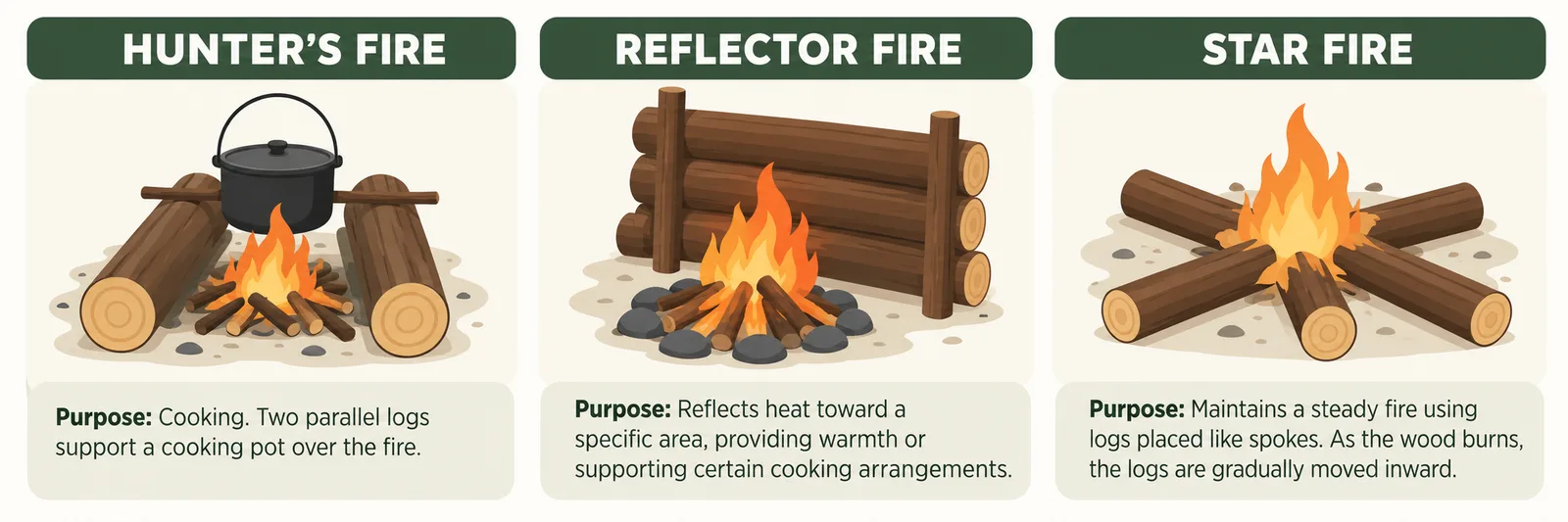
Different campfire arrangements serve different purposes. Understanding these designs helps campers select an appropriate arrangement for their needs, where open fires are permitted.
Hunter's Fire
A hunter's fire traditionally uses two parallel green or noncombustible supports with a small fire between them. Historically, this arrangement was used for cooking because a pot could be supported above the heat.
Primary use: Cooking.
Reflector Fire
A reflector fire uses a fire positioned near a reflector designed to redirect some radiant heat toward a particular area. Traditionally, campers used a log wall or other structure as the reflector. A reflector does not make an unsafe fire location safe. Never build one near tents, combustible shelters, or vegetation.
Primary use: Providing directed warmth or supporting certain outdoor cooking arrangements.
Star Fire
A star fire uses several logs arranged with their ends pointing toward a central burning area. As the wood burns, the logs are gradually moved inward.
Primary use: Maintaining a relatively small fire while using longer pieces of wood.
Instructor activity
Have Pathfinders identify the three arrangements using diagrams or models. Where fires are permitted and conditions are safe, demonstrate the designs under qualified adult supervision. Ask students to explain the advantages and limitations of each arrangement.
✍️ Personal story opportunity
Have you ever used a particular campfire arrangement for cooking or warmth? Describe what worked and what you would do differently.
5. Starting a Fire Without Matches
Requirement: Know six ways to start a fire without a match. Build a campfire using one of these:
- Compressed air
- Curved glass
- Flint
- Friction
- Metal match
- Spark
Before matches and modern lighters became common, people relied on different methods to create the heat needed to ignite combustible materials. Learning these methods helps Pathfinders understand combustion and appreciate traditional outdoor skills. In addition, being able to start a fire without a match is such an amazing feeling that pathfinders will find exciting!
Understanding the fire triangle
Every fire requires three elements:
Heat + Fuel + Oxygen
Removing any one of these elements will extinguish a fire. This principle is important not only for starting fires but also for preventing and extinguishing them.
Six fire-starting methods
Compressed air
A fire piston rapidly compresses air, raising its temperature enough to ignite suitable tinder. This demonstrates how compression can generate heat.
Curved glass
A magnifying glass or other suitable lens can concentrate sunlight onto a small area. This method depends on direct sunlight and appropriate conditions.
Flint
Traditional flint-and-steel techniques produce sparks when a hard stone strikes suitable steel. Those sparks can ignite specially prepared tinder.
Friction
Friction methods generate heat through repeated movement between pieces of wood. Examples include bow drills and hand drills. These methods require practice, suitable materials, and considerable patience.
Metal match
A ferrocerium rod, commonly called a ferro rod, produces hot sparks when scraped with an appropriate striker. This is a popular tool for outdoor emergency kits.
Spark
Electrical or mechanical spark-producing devices can provide an ignition source. This category overlaps with some of the other methods, so instructors should explain the distinctions used in their conference's honor curriculum.
Instructor activity
Demonstrate several ignition methods without necessarily lighting a full campfire. Discuss their reliability in different weather conditions. For the practical requirement, allow students to demonstrate one method only in a designated, controlled area with qualified adult supervision.
Safety note: Never use concentrated sunlight near dry vegetation, tents, or other combustible materials. Do not conduct ignition demonstrations during fire restrictions.
✍️ Personal story opportunity
Which fire-starting methods have you tried? Was one surprisingly difficult? Sharing an unsuccessful attempt could be especially useful for students.
About this honor
- Category
- Recreation
- Skill level
- 2
- Division
- General Conference
- Edition
- 2001
- Original honor
- 1997
Requirements are published by AdventSource for the General Conference of Seventh-day Adventists. Advent Clubs reproduces them here for club leaders and links the original document above.